

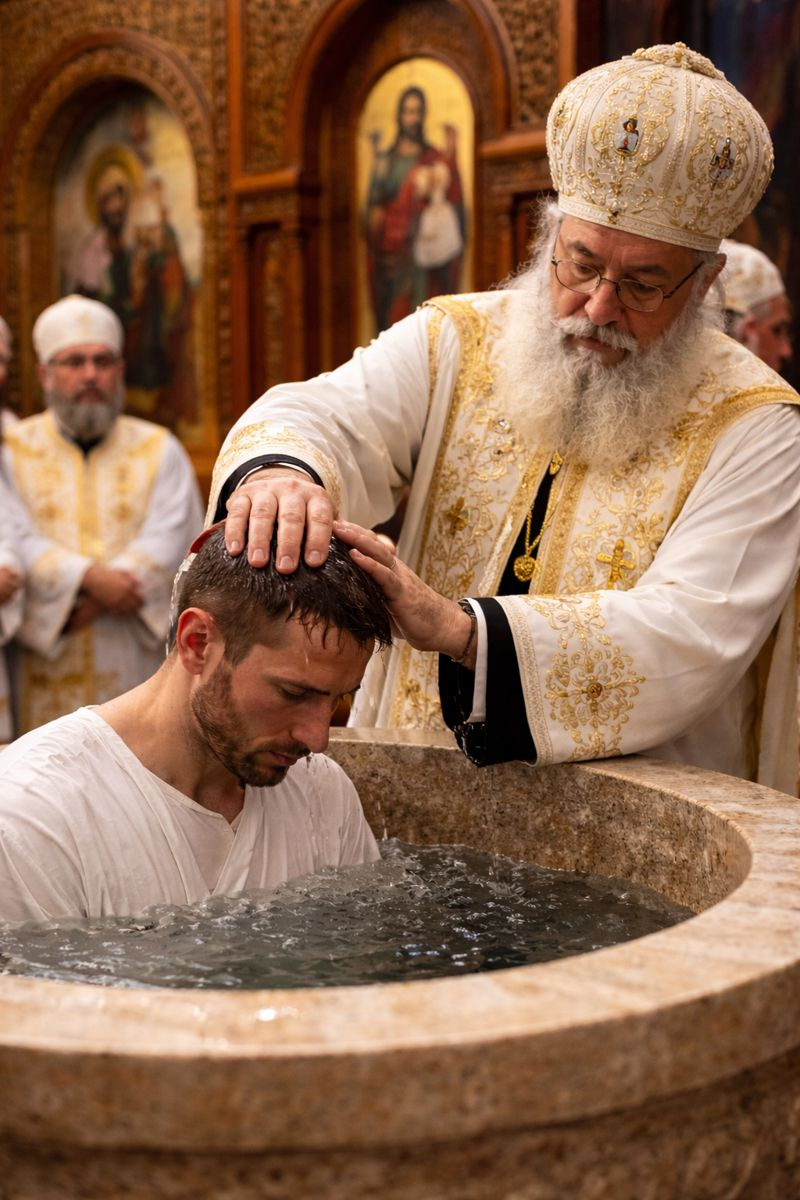
St. Ambrose says that after explaining holy living, he will now explain the Mysteries. He then gives his reasons for not having done so earlier, and explains the mystery of the opening of the ears, showing how Christ Himself performed this long ago.
1. We have spoken day by day about matters of moral conduct, while the deeds of the Patriarchs or the precepts of the Proverbs were being read, so that, taught and instructed by these, you might grow accustomed to enter the ways of the ancients, to walk in their paths, and to obey the divine commands. This was done so that, being renewed by baptism, you might hold fast to the way of life that befits those who have been washed.
2. The present season now urges us to speak of the Mysteries and to explain the meaning of the sacraments. If we had thought it right to teach these before baptism to those who were not yet initiated, we would have seemed rather to betray the Mysteries than to set them forth. There is also another reason: the very light of the Mysteries shines more powerfully on those who are expecting something they do not yet understand, than if any explanation had been given beforehand.
3. Open your ears, then, and breathe in the sweet fragrance of eternal life that has been breathed upon you by the grace of the sacraments. This was symbolically shown to you by us when, in celebrating the mystery of the opening, we said, “Epphatha,” that is, “Be opened,” so that whoever came seeking peace might know what was asked of him and be bound to remember what he answered.
4. Christ Himself used this mystery in the Gospel, as we read, when He healed the man who was deaf and mute. He touched the mouth because the one who was healed was mute and was a man: in one respect, so that he might open his mouth with the sound of the voice given to him; in another respect, because such a touch was fitting for a man, but would not have been fitting for a woman.
What those who were to be initiated promised on entering the Church, who witnessed these promises, and why they then turned toward the East.
5. After this, the Holy of Holies was opened to you, and you entered the sanctuary of rebirth. Recall what you were asked, and remember what you answered. You renounced the devil and his works, and the world with its luxury and pleasures. That declaration of yours is not recorded in the tombs of the dead, but in the book of the living.
6. There you saw the deacon, you saw the priest, and you saw the chief priest (that is, the bishop). Do not fix your attention on their bodily appearance, but on the grace of the Mysteries. You spoke in the presence of angels, as it is written: “For the priest’s lips keep knowledge, and men seek the law from his mouth, for he is the angel of the Lord Almighty.” There is no room here for deceit or denial. He is called an angel because he proclaims the kingdom of Christ and eternal life. He is to be regarded by you not according to outward appearance, but according to his office. Consider what he handed on to you, reflect on the rule of life he gave you, and recognize the authority of his position.
7. You entered, then, in order to recognize your adversary, whom you were to renounce, as it were, face to face. Then you turned toward the east; for one who renounces the devil turns toward Christ and looks upon Him face to face.
St. Ambrose points out that we must attend to the divine presence and action in the water and in the sacred ministers, and then sets forth many Old Testament figures of baptism.
8. What did you see? Water, certainly—but not water alone. You saw the deacons ministering there, and the bishop questioning and consecrating. Above all, the Apostle has taught you that we are to consider “not the things that are seen, but the things that are not seen; for the things that are seen are temporal, but the things that are not seen are eternal.” For elsewhere you read: “The invisible things of God, from the creation of the world, are clearly understood through the things that are made; His eternal power also and Godhead are perceived through His works.” Therefore the Lord Himself also says: “If you do not believe Me, believe at least the works.” Believe, then, that the presence of the Godhead is there. Do you believe in the working, and yet deny the presence? From where could the working come, unless the presence came first?
9. Consider, moreover, how ancient this mystery is, foreshadowed even at the very beginning of the world. At the start, when God made heaven and earth, “the Spirit,” it is said, “was moving over the waters.” He who was moving over the waters—was He not at work upon the waters? But why should I say “at work”? In regard to His presence, He was moving. Was He not working who was moving? Recognize that He was working in the creation of the world, when the prophet says: “By the word of the Lord the heavens were made, and all their host by the Spirit of His mouth.” Each statement rests on prophetic testimony: Moses says He was moving; David testifies that He was working.
10. Take another witness. All flesh had been corrupted by its iniquities. “My Spirit,” says God, “shall not remain in men, because they are flesh.” By this God shows that the grace of the Spirit is withdrawn by carnal impurity and the defilement of grave sin. Therefore God, wishing to restore what was lost, sent the flood and commanded the just Noah to enter the ark. After the flood subsided, Noah first sent out a raven, which did not return, and then sent out a dove, which returned carrying an olive branch. You see the water, you see the wood, you see the dove—do you still hesitate about the mystery?
11. The water, then, is that in which the flesh is immersed, so that every carnal sin may be washed away. All wickedness is buried there. The wood is that on which the Lord Jesus was fastened when He suffered for us. The dove is the form in which the Holy Spirit descended, as you read in the New Testament, inspiring peace of soul and tranquillity of mind. The raven represents sin, which goes out and does not return, if righteousness is preserved within you, both inwardly and outwardly.
12. There is also a third witness, as the Apostle teaches: “All our fathers were under the cloud, and all passed through the sea, and all were baptized into Moses in the cloud and in the sea.” Moses himself also says in his song: “You sent forth Your Spirit, and the sea covered them.” You see that even then holy baptism was prefigured in the crossing of the Hebrews, where the Egyptian perished and the Hebrew escaped. For what else are we taught daily in this sacrament, except that guilt is swallowed up and error destroyed, while virtue and innocence remain unharmed?
13. You hear that our fathers were under the cloud—a kindly cloud that cooled the heat of carnal passions. That kindly cloud overshadows those whom the Holy Spirit visits. At last it came upon the Virgin Mary, and the power of the Most High overshadowed her, when she conceived the redemption of the human race. That miracle was foreshadowed through Moses. If, then, the Spirit was present in the figure, is He not present in the reality, since Scripture says: “The law was given through Moses; grace and truth came through Jesus Christ”?
14. Marah was a spring of exceedingly bitter water; Moses cast wood into it, and the water became sweet. For water without the proclamation of the Lord’s cross is of no benefit for future salvation; but once it has been consecrated by the mystery of the saving cross, it becomes fit for the spiritual bath and the cup of salvation. As Moses—the prophet—cast wood into the spring, so the priest proclaims the cross of the Lord over this font, and the water is made sweet for the work of grace.
15. Therefore do not trust entirely in bodily sight. What is not seen is more truly perceived; for what is seen is temporal, but what is unseen is eternal, grasped not by the eye but by the mind and the spirit.
16. Finally, let the lesson recently read from the Books of Kings instruct you. Naaman was a Syrian and suffered from leprosy, and no one could cleanse him. A captive young girl said that there was a prophet in Israel who could cleanse him from his leprosy. Taking silver and gold, he went to the king of Israel. When the king heard why he had come, he tore his clothes, thinking that a pretext for hostility was being sought, since demands were made of him that were beyond a king’s power. But Elisha sent word that the Syrian should be sent to him, so that he might know that there was a God in Israel. When Naaman came, Elisha commanded him to wash seven times in the River Jordan.
17. Naaman began to reason with himself, saying that he had better rivers in his own land, in which he had often bathed without being cleansed of his leprosy. For this reason he at first refused to obey the prophet’s command. Yet, persuaded by his servants, he consented and washed—and immediately he was cleansed. Then he understood that it is not by the water itself, but by grace, that a person is cleansed.
18. Understand now who that young captive girl represents. She is the Church gathered from the Gentiles, once held in the captivity of sin, before she possessed the freedom of grace. By her counsel the foolish Gentile people heard the prophetic word which they had previously doubted. Afterwards, when they believed it should be obeyed, they were washed from every defilement of sin. He doubted before he was healed; you are already healed, and therefore ought not to doubt.
That water does not cleanse without the Spirit is shown by the testimony of John and by the very manner in which the sacrament is administered. This is also shown figuratively by the pool in the Gospel and by the healing of the man who lay there. In the same passage it is also shown that the Holy Spirit truly descended upon Christ at His baptism, and the meaning of this mystery is explained.
19. The reason why you were previously told not to believe only what you see was so that you would not perhaps say: This is that great mystery “which eye has not seen, nor ear heard, nor has it entered into the heart of man.” I see water, which I am accustomed to seeing every day. Is this water now to cleanse me, when I have so often bathed in it without ever being cleansed? From this you may understand that water does not cleanse without the Spirit.
20. Therefore read that the three witnesses in baptism—the water, the blood, and the Spirit—are one; for if you remove any one of these, the sacrament of baptism does not exist. For what is water without the cross of Christ? It is a common element, without any sacramental power. Nor again is there the sacrament of regeneration without water: “Unless a man is born again of water and the Spirit, he cannot enter the kingdom of God.” Even the catechumen believes in the cross of the Lord Jesus, and is signed with it; but unless he is baptized in the Name of the Father, and of the Son, and of the Holy Spirit, he cannot receive the forgiveness of sins nor obtain the gift of spiritual grace.
21. That Syrian dipped himself seven times under the Law, but you were baptized in the Name of the Trinity. You confessed the Father—recall what you did—you confessed the Son, you confessed the Holy Spirit. Observe carefully the order of this faith: you died to the world and rose again to God. And as though buried to the world in that element, being dead to sin, you rose again to eternal life. Believe, therefore, that these waters are not without power.
22. Therefore it is written: “An angel of the Lord went down at a certain time into the pool and troubled the water; and whoever first went down into the pool after the troubling of the water was healed of whatever disease he had.” This pool was in Jerusalem, and in it one person was healed each year, but no one was healed before the angel descended. Because of those who did not believe, the water was troubled as a sign that the angel had come down. They had a sign; you have faith. For them an angel descended; for you the Holy Spirit. For them the creature was troubled; for you Christ Himself, the Lord of the creature, works.
23. Then one person was healed; now all are healed—or rather, the Christian people alone. For in some cases even the water is deceptive. The baptism of unbelievers does not heal but pollutes. The Jew washes pots and cups, as though lifeless things were capable of guilt or grace. But you wash this living vessel of yours, so that good works may shine within it and the glory of grace may be radiant. For that pool was a figure, so that you might believe that the power of God descends upon this font.
24. Finally, that paralytic was waiting for a man. And what man could this be except the Lord Jesus, born of the Virgin, at whose coming no longer a shadow would heal men one by one, but the truth would heal all together? He, then, was the one whose coming was awaited, of whom the Father said to John the Baptist: “Upon whom you see the Spirit descending and remaining upon Him, this is He who baptizes with the Holy Spirit.” And John bore witness to Him and said: “I saw the Spirit descending from heaven like a dove and remaining upon Him.” And why did the Spirit descend like a dove, except so that you might see and understand that the dove which Noah once sent out from the ark was a figure of this dove, and so recognize the type of the sacrament?
25. Perhaps you may object: since that was a real dove which was sent out, and the Spirit descended like a dove, how can we say that there the likeness was present and here the reality, when in Greek it is written that the Spirit descended in the likeness of a dove? But what is more real than the Godhead, which abides forever? A creature cannot be the reality, but only a likeness, since it is easily destroyed and changed. Further, the simplicity required of those who are baptized should be real, not merely apparent; as the Lord says: “Be wise as serpents and innocent as doves.” Therefore He rightly descended like a dove, to remind us that we ought to possess the dove’s simplicity. Moreover, we also read that likeness is used for reality both of Christ—“being found in the likeness of a man”—and of God the Father—“nor have you seen His likeness.”
Christ Himself is present in Baptism, so that we need not concern ourselves with the personal worth of His ministers. A brief explanation is also given of the confession of the Trinity as it is ordinarily made by those about to be baptized.
26. Is there, then, any room left for doubt, when in the Gospel account the Father clearly speaks from heaven and says: “This is My beloved Son, in whom I am well pleased”? When the Son also speaks, upon whom the Holy Spirit appeared in the likeness of a dove? When the Holy Spirit also speaks, who came down in the likeness of a dove? When David, too, declares: “The voice of the Lord is above the waters; the God of glory thundered; the Lord is above many waters”? And when Scripture testifies that at the prayer of Jerubbaal fire came down from heaven, and again that when Elijah prayed, fire was sent forth and consecrated the sacrifice?
27. Do not consider the personal merits of individuals, but the office of the priest. Or if you do consider merits, then regard the priest as Elijah. Consider also the merits of Peter or of Paul, who handed down to us this mystery which they themselves received from the Lord Jesus. To those of old a visible fire was sent so that they might believe; for us who already believe, the Lord works invisibly. For them it happened as a figure; for us it is a warning. Believe, then, that the Lord Jesus is present at the invocation of the priest, He who said: “Where two or three are gathered together, there am I in the midst of them.” How much more, then, where the Church is gathered, and where His mysteries are celebrated, does He graciously grant His presence!
28. You went down into the water, then—remember what you answered to the questions—that you believe in the Father, that you believe in the Son, that you believe in the Holy Spirit. The confession is not: I believe in a greater, a lesser, and a lowest being. Rather, by the same pledge of your own voice, you are bound to believe in the Son in the same way as you believe in the Father, and to believe in the Holy Spirit in the same way as you believe in the Son—with this one distinction only, that you confess that you must believe in the cross of the Lord Jesus alone.
Why those who come forth from the laver of baptism are anointed on the head; why also, after baptism, their feet are washed; and what sins are remitted in each case.
29. After this, you went up to the priest. Consider what followed. Was it not what David speaks of: “Like the ointment upon the head, which ran down upon the beard, even Aaron’s beard”? This is the ointment of which Solomon also says: “Thy Name is ointment poured forth; therefore have the maidens loved Thee and drawn Thee.” How many souls, regenerated this day, have loved Thee, Lord Jesus, and have said: “Draw us after Thee; we are running after the fragrance of Thy garments,” that they might take in the sweetness of Thy resurrection.
30. Consider now why this is done. For “the eyes of a wise man are in his head”; therefore the ointment flows down to the beard—that is, to the strength and dignity of mature life—and specifically to Aaron’s beard, so that we too may become a chosen race, priestly and precious. For we are all anointed with spiritual grace, to share in the kingdom of God and in the priesthood.
31. You came up from the font; recall the Gospel reading. Our Lord Jesus Christ in the Gospel washed the feet of His disciples. When He came to Simon Peter, Peter said to Him: “Thou shalt never wash my feet.” He did not yet understand the mystery, and therefore he refused the service, thinking that the dignity of the Master would be compromised if He patiently performed a servant’s task. But the Lord answered him: “If I wash thee not, thou hast no part with Me.” Hearing this, Peter replied: “Lord, not my feet only, but also my hands and my head.” The Lord answered: “He that is washed needeth not save to wash his feet, but is clean every whit.”
32. Peter was clean, yet he still needed to have his feet washed. For he bore sin by inheritance from the first man, when the serpent overthrew him and persuaded him to sin. Therefore his feet were washed, so that hereditary sins might be removed; for our own personal sins are remitted through baptism.
33. Observe at the same time that this mystery lies also in the act of humility itself. For Christ says: “If I then, your Lord and Master, have washed your feet; how much more ought you to wash one another’s feet.” Since the Author of salvation Himself redeemed us through obedience, how much more should we, His servants, offer the service of humility and obedience.
The washing away of sins is shown by the white robes of the catechumens. From this the Church calls herself black and beautiful. Angels marvel at her brightness, as they once marveled at the flesh of the Lord. Christ Himself praises her beauty to His Bride under many images, and the mutual love between them is described.
34. After this, white garments were given to you as a sign that you had put off the clothing of sin and put on the pure garment of innocence, of which the prophet says: “Thou shalt sprinkle me with hyssop, and I shall be cleansed; Thou shalt wash me, and I shall be made whiter than snow.” For the one who is baptized is seen to be cleansed both according to the Law and according to the Gospel: according to the Law, because Moses sprinkled the blood of the lamb with a bunch of hyssop; according to the Gospel, because Christ’s garments became white as snow when, in the Gospel, He revealed the glory of His Resurrection. Thus, the one whose guilt is forgiven is made whiter than snow. Hence God says through Isaiah: “Though your sins be as scarlet, I will make them white as snow.”
35. The Church, having put on these garments through the laver of regeneration, says in the Song of Songs: “I am black and beautiful, O daughters of Jerusalem.” Black because of the weakness of her human condition, beautiful because of the sacrament of faith. And the daughters of Jerusalem, seeing these garments, say in wonder: “Who is this that comes up made white?” She was black—how has she suddenly been made white?
36. The angels, too, were in doubt when Christ rose; the powers of heaven were amazed when they saw flesh ascending into heaven. Then they said: “Who is this King of glory?” And while some said, “Lift up your gates, O princes, and be lifted up, you everlasting doors, and the King of glory shall enter,” in Isaiah also we read that the powers of heaven wondered and said: “Who is this that comes up from Edom, with garments red from Bozrah, glorious in white apparel?”
37. But Christ, looking upon His Church—for whom, as we read in the prophet Zechariah, He Himself had once clothed in filthy garments—now sees her clothed in white raiment, that is, a soul made pure and washed in the laver of regeneration, and says: “Behold, thou art fair, My love; behold, thou art fair; thine eyes are like a dove’s,” in whose likeness the Holy Spirit descended from heaven. Her eyes are beautiful like a dove’s, because the Holy Spirit descended from heaven in the likeness of a dove.
38. And further: “Thy teeth are like a flock of sheep that are shorn, which have come up from the pool; they all bear twins, and none among them is barren; thy lips are like a scarlet cord.” This is no slight praise. First, there is the pleasing comparison with sheep that are shorn; for such animals graze securely even on high and rugged ground, and once shorn are freed from what is superfluous. The Church is likened to such a flock, having within herself many virtues of souls who, through the laver, have laid aside the excess of sin and offer to Christ mystical faith and the grace of good living, which proclaim the cross of the Lord Jesus.
39. In these she is beautiful. Therefore God the Word says to her: “Thou art all fair, My love, and there is no blemish in thee,” for guilt has been washed away. “Come hither from Lebanon, My spouse, come hither from Lebanon; from the beginning of faith thou shalt pass through and pass on,” because by renouncing the world she passed through temporal things and passed on to Christ. And again God the Word says to her: “How beautiful and how sweet thou art, O love, in thy delights! Thy stature is like a palm-tree, and thy breasts like clusters of grapes.”
40. And the Church answers Him: “Who will give Thee to me, my Brother, who didst suck the breasts of my mother? If I find Thee outside, I will kiss Thee, and they will not despise me. I will take Thee and bring Thee into the house of my mother, into the inner chamber of her who conceived me. Thou shalt teach me.” You see how, rejoicing in the gifts of grace, she longs to reach the innermost mysteries and to consecrate all her affections to Christ. She still seeks Him, still stirs up His love, and asks the daughters of Jerusalem to stir it up for her, desiring that by their beauty—that is, the beauty of faithful souls—her Bridegroom may be moved to ever deeper love for her.
41. Therefore the Lord Jesus Himself, drawn by such eager love and by the beauty of holiness and grace—since now no sin defiles the baptized—says to the Church: “Set Me as a seal upon thy heart, as a signet upon thine arm.” That is, you are beautiful, My beloved; you are altogether fair; nothing is lacking in you. Set Me as a seal upon your heart, that your faith may shine in the fullness of the sacrament. Let your works also shine and display the image of God, in whose image you were made. Let no persecution diminish your love, which many waters cannot quench nor rivers overwhelm.
42. And remember that you received the seal of the Spirit: the spirit of wisdom and understanding, the spirit of counsel and strength, the spirit of knowledge and godliness, and the spirit of holy fear. Preserve what you have received. God the Father sealed you, Christ the Lord strengthened you, and He gave you the pledge of the Spirit in your heart, as you learned from the reading of the Apostle.