

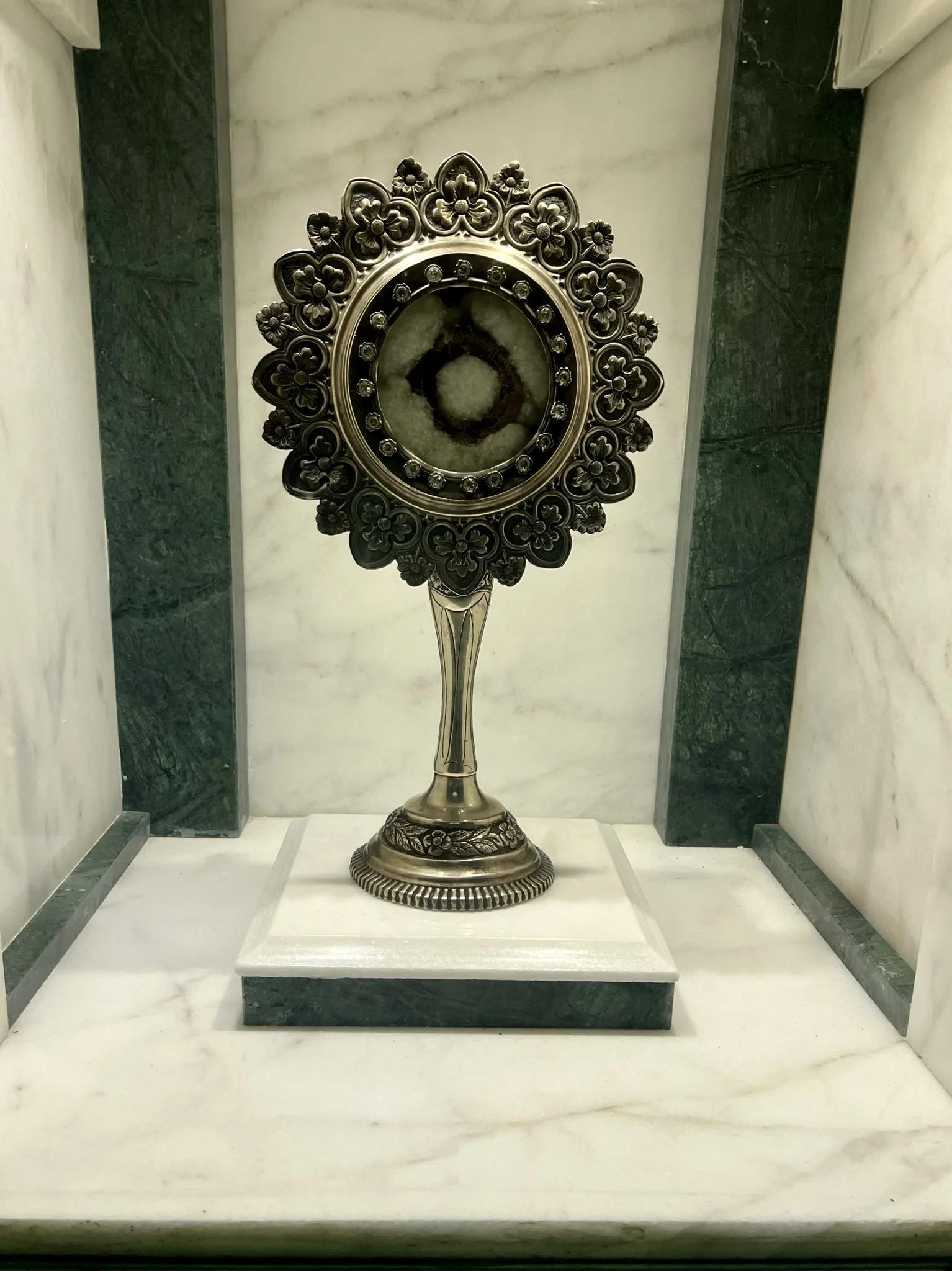
Among the ancient traditions associated with the Virgin Mary, the Mother of God, is that of her girdle, or belt. This tradition is found in several parts of the Christian East, but it has a particular importance in the Syriac Orthodox Church, where a relic believed to be part of the girdle has been preserved for many centuries in the city of Homs in Syria.
The tradition belongs to the wider accounts of the departure of the Virgin Mary from this life and her being taken into heavenly glory. These accounts are not part of the New Testament, and we should not treat all of their details as though they were. Nevertheless, they are ancient, and they show us something of what Christians in the early centuries believed and celebrated concerning the Mother of God. According to the tradition, when the Virgin Mary came to the end of her earthly life, the Apostles were gathered to be with her. St Thomas, however, was absent. In this respect the story has an interesting similarity with the account of the Resurrection in the Gospel of St John, when Thomas was also absent from the gathering of the Apostles.
The tradition says that Thomas was granted a vision of the Virgin Mary being taken into heaven, and that she gave him her girdle as a sign and testimony of what he had seen. There is something particularly appropriate about Thomas being given such a sign. At the Resurrection he had wanted to see and touch before he could believe. Here again he is given something tangible, something which could be seen and touched, as a testimony to the glory which God had bestowed upon the Virgin Mary.
St Thomas and the Syriac world
The connection with St Thomas is especially significant within the Syriac tradition. Thomas was remembered from very early times as the Apostle of the East. His memory was particularly associated with Edessa, known in Syriac as Urhoy, one of the most important centres of early Syriac Christianity. His missionary tradition also extends further eastwards, ultimately reaching the ancient Thomas Christian communities of India.
According to the Syriac Orthodox tradition, the girdle was preserved in connection with St Thomas and eventually came to Edessa, where the relics of the Apostle himself were also venerated. The tradition then tells us that in AD 476 the girdle was brought from Edessa to Homs by a priest named David, who came from the region of Tur Abdin. It was placed in the Church of the Virgin Mary there, which in time became especially associated with the relic and was known as the Church of Our Lady of the Girdle, or Umm al-Zennar. This places the tradition very firmly within the ancient geography of Syriac Christianity: Edessa, Tur Abdin and Homs were all important centres of Syriac Christian life.
The girdle is hidden
The later history of the relic becomes rather easier to follow. In 1852 the ancient church at Homs was being rebuilt and enlarged. During the work, a container was discovered within the altar containing what the local Christian community understood to be the girdle of the Virgin Mary. The relic was not removed permanently but was placed once again within the altar of the rebuilt church. As the years passed, however, knowledge of its exact location was lost.
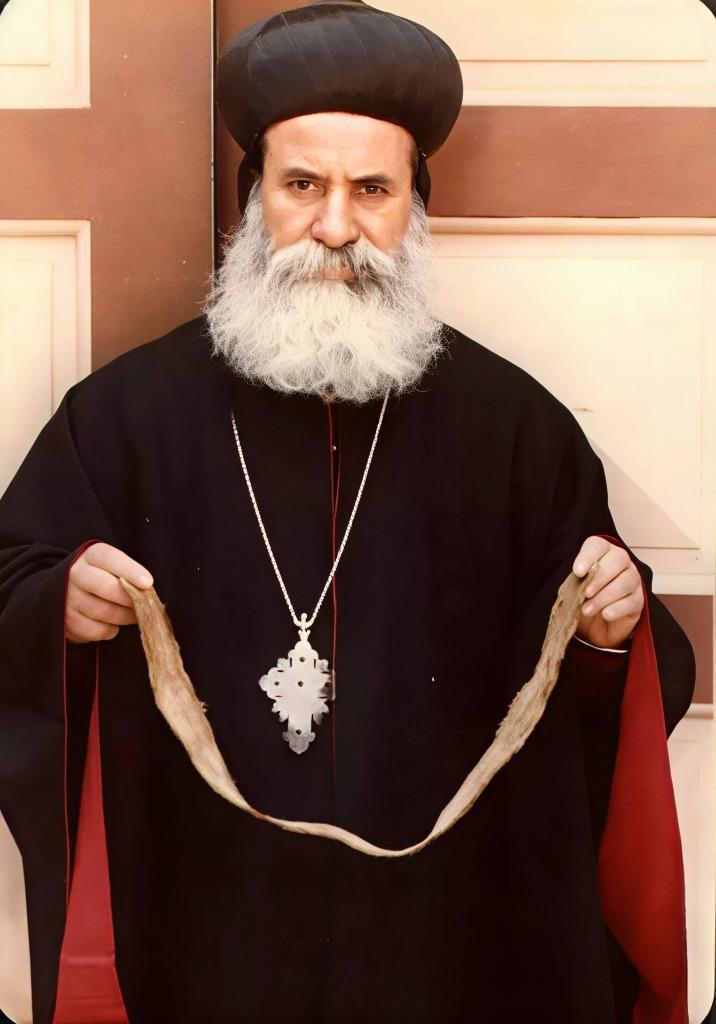
Almost a century later, in 1953, the Syriac Orthodox Patriarch Mor Ignatius Aphrem I Barsoum was studying old manuscripts and documents. Patriarch Aphrem was himself one of the great Syriac scholars of the twentieth century, with an extensive knowledge of the history and literature of his Church. Among the documents he examined were nineteenth-century letters relating to the Diocese of Homs. One of these described the rebuilding of the church in 1852 and, importantly, recorded the discovery of the girdle and the place where it had subsequently been concealed.
On 20 July 1953 the relevant part of the altar was opened in the presence of the Patriarch and other witnesses. Beneath a stone tablet they discovered a small stone basin covered with a copper plate. Inside was an old cylindrical metal container which had become badly oxidised. Within it was the girdle.
This part of the story is important because the relic did not simply appear in Homs in the twentieth century. The Patriarch was searching for something which documentary evidence showed had already been present in the church a century earlier, and which the Christian community of Homs believed had been preserved there for many centuries before that.
What does the girdle look like?
The relic itself is very simple. The surviving portion is about 74 centimetres long and 5 centimetres wide, and only a few millimetres thick. It is principally made from woollen threads, although linen and silk have also been identified in its construction, and there are traces of gold embroidery. It is worn and damaged, not least because it had remained for so long inside an oxidising metal container. It certainly does not look like the sort of impressive object which someone might create in order to attract pilgrims. It is simply an old and rather fragile piece of woven material.
Of course, this immediately raises the question which we naturally ask whenever we encounter an ancient relic. Did this girdle actually belong to the Virgin Mary? The answer must be that we cannot prove that it did. There is no continuous documentary record taking us from the Virgin Mary in the first century, through St Thomas and Edessa, and finally to Homs. The tradition that Thomas received the girdle at the Assumption belongs to the ancient tradition of the Church rather than to the historical record in the modern sense.
But this does not mean that there is no history here. The association of St Thomas with the Syriac East is certainly ancient. Edessa was one of the principal centres in which his memory and relics were preserved. The tradition of the girdle became established within Syriac Christianity, and the church at Homs itself was known because of the presence of the relic. Finally, when the girdle was rediscovered in 1953, it was found precisely where nineteenth-century documents said that an already existing relic had been concealed. We should therefore avoid making claims which the evidence cannot support, but neither is there any reason to dismiss an ancient tradition simply because we cannot establish every stage of its history.
The girdle survives the war in Syria
The girdle has also shared in the much more recent suffering of the Christians of Syria. During the Syrian conflict the Church of Our Lady of the Girdle in Homs was badly damaged. The city itself experienced terrible fighting, and the ancient Christian communities suffered alongside their neighbours. The relic survived because it had been removed for safekeeping.
After the restoration of the cathedral, a new shrine was prepared for the girdle, and in August 2022 Patriarch Mor Ignatius Aphrem II inaugurated the shrine and returned the relic to the restored church. There is something especially moving about seeing this ancient relic returned to a church which had itself been so badly damaged. For generations the Christians of Homs had prayed before it. Now, after all the suffering of recent years, it remains among them.
Why do relics matter?
It is possible to become too concerned with trying to prove or disprove the authenticity of every ancient relic. Certainly we should be historically responsible. We should not say that we know something when we do not know it. But relics also belong to the life of the Church rather than simply to the study of archaeology. Our Christian faith is founded upon the truth that the Word became flesh.
God entered the material world which He had created. Our Lord Jesus Christ could be seen and heard and touched. The woman who had suffered from bleeding for twelve years touched the edge of His garment and was healed. In the Acts of the Apostles we even read that handkerchiefs and aprons which had touched St Paul were taken to the sick. The early Christians did not think that holiness belonged only to the invisible and spiritual world. They understood that because God had truly become man, the material creation could become a bearer of grace.
This is why Christians preserved the bodies of the martyrs. It is why they treasured things associated with the saints. It is why they travelled to the places where the saints had lived and prayed. And this is also the proper context in which we should understand the girdle of the Virgin Mary. The Virgin Mary was not simply a theological idea or a figure in an icon. She was a real woman who lived in a particular place and at a particular time. She walked along ordinary roads. She prepared meals. She wore ordinary clothes. She carried the infant Christ in her arms. Above all, she gave her own humanity to the Word of God.
Whether we can ever establish with certainty that this particular piece of cloth was once worn by the Virgin Mary is therefore not finally the most important question. For many centuries the Christians of the Syriac tradition have received it as a precious connection with the Mother of God. They have prayed in its presence through periods of prosperity and persecution. Bishops and priests have guarded it. Generations of ordinary Christian people have approached it with faith. And its significance is not found simply in the cloth itself.
Like every authentic devotion to the Virgin Mary, it points us towards her Son. The girdle reminds us that the Mother of God was a real woman who lived in our world, and that the Son whom she bore truly received our humanity from her. The Word became flesh and dwelt among us. And because He truly shared our material human existence, even something as ordinary as a piece of cloth can remind us that our salvation is not an idea. It is something which has happened in our world, in our history, and in our flesh.